
Central Air Repair in Austin, TX
Central air conditioning repair for split systems in Austin homes, including the air handler, the coil, the blower and the ducts.
Call (737) 295-1994Central Air Systems in Austin Homes
A central air system is two halves joined by copper lines and wiring. The outdoor condenser rejects heat. The indoor air handler, or a furnace with a coil on top, moves the air through the ducts. In Austin the indoor half is often in the attic, sometimes in a hall closet or the garage. Meritt HVAC Repair repairs both halves and the ductwork that connects them to each room.
Problems on the indoor side are easy to miss because few people go into the attic to look. A blower motor can weaken for months before it fails. A duct can slip off a register boot and dump cold air into the attic. An evaporator coil can load up with dust until airflow drops and the coil freezes.
Central AC Repair Work
- Air handlers and blower motors, including variable speed motors and their modules
- Evaporator coils, drain pans and condensate pumps
- Flex duct runs that have torn, collapsed or come loose
- Return air grilles, filter racks and undersized returns
- Zone dampers and zone control boards
- Condenser fan motors, capacitors and contactors
- Thermostats and thermostat wiring
Duct and Airflow Problems in Older Austin Houses
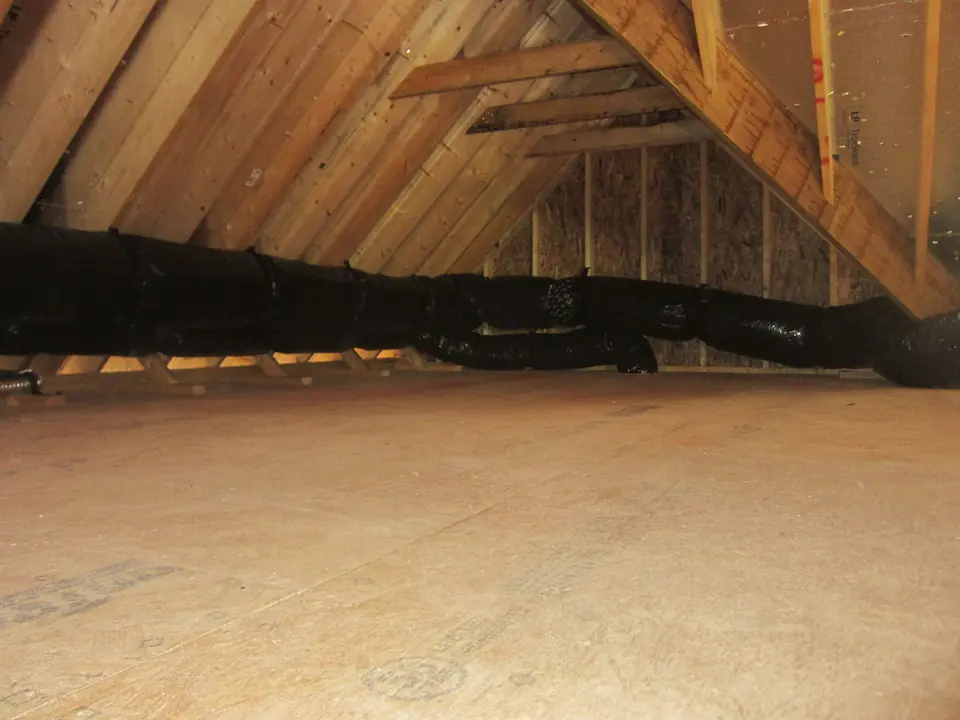
Many older houses in Allandale, Old West Austin and Hyde Park were not built for central air. Ducts were added later, often as flex duct laid across the attic floor, and returns were sized small. Weak airflow from those layouts leads to frozen coils, rooms that never cool and blower motors that work harder than they should.
Newer construction has its own issues. At Mueller, the systems are newer but attic space is tight and many air handlers sit in small closets with little room around the filter and drain.
Central Air Repair Questions
- How does central air work?
- The indoor blower pulls room air through the return and the filter, then pushes it across a cold evaporator coil. The coil absorbs heat and pulls moisture out of the air, which drips into a pan and drains away. Copper lines carry that heat to the outdoor condenser, where a fan blows it off the coil and into the yard. The cooled air goes back to the rooms through the ducts.
- Why does my central air freeze up at night?
- Nighttime freezing often comes from low airflow combined with cooler outdoor air. When it is cooler outside, the coil runs colder, and if the filter is dirty, the blower is weak or a return is blocked, the coil drops below freezing. A thermostat set very low overnight makes it worse. If ice keeps forming, the airflow problem or a system fault needs to be found.
- Why does my central air conditioner smell musty?
- A musty smell usually comes from moisture where it should not sit: a drain pan that holds water, a dirty coil, mold inside the air handler, or duct insulation that got wet from an overflow. Attic air handlers that sit out of sight are the most likely to develop it. Cleaning the pan and coil, clearing the drain and fixing the source of standing water takes care of most cases.
- Why does my central air keep tripping the breaker?
- A breaker that trips each time the system starts points to a part drawing too much current. The usual causes are a failed capacitor, a compressor that is hard to start, a shorted fan motor, or a wire rubbing through its insulation inside the cabinet. A dirty condenser coil on a hot day can push a weak compressor over the edge. Leave the breaker off after a second trip and call.
- Why does my central air have two filters?
- Some houses have two return grilles, each with its own filter, because one return was too small to feed the blower. Others have a filter at the return grille and a second slot at the air handler. Both setups are common in Austin homes where ducts were added later. Every filter in the path needs changing, and a missed one can choke airflow.
- Why does my central air never shut off?
- If it runs nonstop on a cool day, check that the thermostat is set to auto and not fan on. A thermostat that is miswired, a stuck contactor that keeps the outdoor unit running, a leaky duct dumping cold air into the attic, or a system that has lost capacity can also keep it running. On the hottest afternoons, long run times alone are normal.
- Is my central air gas or electric?
- Central air conditioning runs on electricity. The question usually comes up because the heating side can be either. If the indoor unit has a flue pipe running up through the roof, the heat is a gas furnace. If there is no flue and the outdoor unit also heats in winter, it is a heat pump. No flue and no heat pump usually means electric heat strips in the air handler.
Central Air Repair Resources
Central Air Repair in Austin, TX
Call (737) 295-1994