
Emergency AC Repair in Austin, TX
When the air conditioner quits and the house keeps getting warmer, call (737) 295-1994 for emergency AC repair.
Call (737) 295-1994Sudden AC Breakdowns
An air conditioner that quits in the middle of the afternoon is more than an annoyance, and a closed house can warm up fast once the cooling stops. If the system has stopped cooling and the house keeps getting warmer, treat it as an emergency and call.
The failures that bring a system down all at once are usually electrical or airflow related. A run capacitor gives out, a contactor burns, a fan motor seizes, a breaker trips, a float switch shuts the system off after a drain clog, or the indoor coil freezes into a block of ice.
Emergency AC Problems in Austin
- Outdoor unit humming with the fan stopped
- System completely dead at the thermostat
- Breaker that trips again after a reset
- Ice on the lines or the indoor coil
- Water overflowing from an attic air handler
- Burning smell from the outdoor unit or the air handler closet
Two quick checks help: make sure the thermostat is set to cool, and look at the filter. A filter packed with dust can starve the coil of air until it freezes, and switching the system to fan only lets the ice melt while you wait for the repair.
Capacitors and Contactors
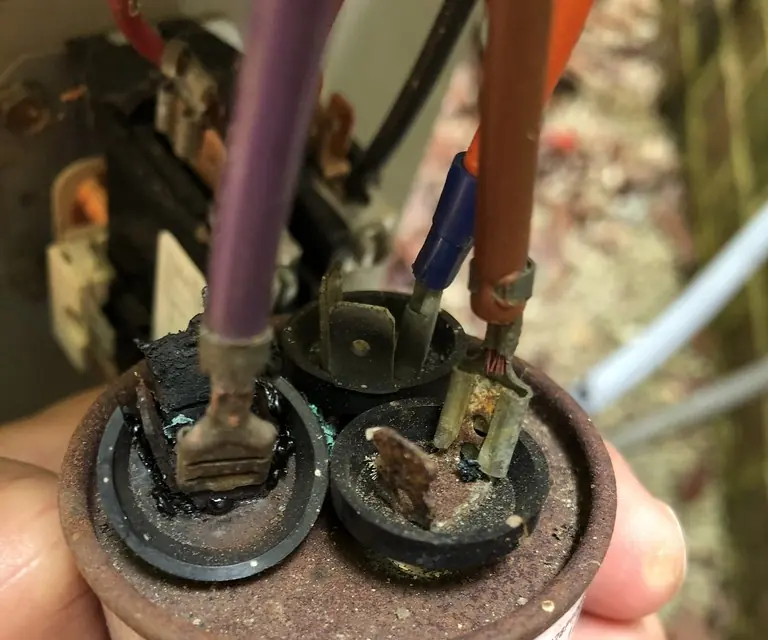
The run capacitor is the most common single part behind a sudden AC failure in Austin. It supplies the extra push the compressor and fan motor need to get turning and stay turning. Heat and age wear it down, and a capacitor that sits in a sun-baked condenser cabinet loses strength until one afternoon it can no longer start the compressor. The contactor, the switch that sends power to the outdoor unit, fails in a similar way after thousands of starts.
Older outdoor units in Travis Heights and Windsor Park often sit close to fences and shrubs, which traps heat around the cabinet. Newer houses at Mueller tend to have smaller side yards with units grouped close together, and the same problem shows up there.
Emergency AC Repair Questions
- How long will AC run with bad capacitor?
- There is no set length. A weak capacitor may let the system limp along for a while, starting slowly and running hot, or it may stop the compressor from starting at all. Running on a failing capacitor makes the compressor and fan motor draw more current and run hotter, which shortens their life. When the outdoor unit hums but the fan does not turn, shut the system off and call.
- Why does my AC keep blowing capacitors?
- Repeat failures usually mean something else is stressing the part. Common causes include a replacement with the wrong microfarad value, a capacitor not built for high heat, a compressor or fan motor that is starting to fail and drawing extra current, low or unstable voltage, and a dirty condenser coil that makes the whole unit run hotter. Each of those needs to be found, or the next capacitor goes the same way.
- Can an AC capacitor be bad without bulging?
- Yes. A bulged top or leaking oil makes a failed capacitor easy to spot, but many lose strength with no visible sign at all. The only way to know is to measure it with a meter against the value printed on its label. A capacitor reading well below its listed value can still let the system run for a while, just not well.
- What happens if AC drain is clogged?
- Water from the coil has nowhere to go, so it backs up into the drain pan. If the system has a float switch, the switch shuts the system off when the water rises, and the house stops cooling. Without one, the pan overflows. With an attic air handler, that water soaks the insulation and drywall below and shows up as a ceiling stain or drip.
- How do I know if my AC unit is frozen?
- Look for frost or ice on the large copper line at the outdoor unit, or on the coil if you can see it at the air handler. Weak airflow from the vents, air that feels cool but not cold, and water around the air handler as ice melts are other signs. Switch the system to fan only to thaw it, check the filter, and call if it freezes again.
- Why did my central air stop working?
- A system that quits all at once usually has a power or control problem. Check the thermostat batteries and settings, the breaker, and the outdoor disconnect. If those are fine, the cause is often a failed capacitor or contactor, a tripped float switch from a clogged drain, a blown fuse on the control board, or a frozen coil. Most of these parts are common and sit inside the outdoor unit or the air handler.
Emergency AC Repair Resources
Emergency AC Repair in Austin, TX
Call (737) 295-1994